Hal Wiseman
The Black-Eyed BlondeHal Wiseman is a studio security officer and an old friend of Philip Marlowe whose usefulness lies in the informal connections of his job. He looks after Excelsior Studios’ young performers, has access to the Sheriff’s Office when studio trouble spills beyond the lot, and helps Marlowe arrange a meeting with Mandy Rogers. His brief appearance gives the investigation a route into Hollywood while presenting a man at ease among its performers and its compromises.
Identity and Work
Wiseman works in the same line as Philip Marlowe, but for Excelsior Studios rather than as an independent detective. His title is chief security officer, though Marlowe qualifies it as “something like that,” and the work sounds less like conventional investigation than a mixture of supervision, damage control, and personal connections. Wiseman babysits starlets and tries to keep younger actors on the straight and narrow—or, as Marlowe puts it, at least not too crooked or too wide.
The job also gives Wiseman occasions to call on his contacts at the Sheriff’s Office. He uses them to help Excelsior’s stars out of dope charges and to ease studio executives away from charges involving drunk driving or wife beating. These examples place him at a boundary between studio protection and law enforcement: the studio has problems that can become public or legal, and Wiseman’s contacts are part of how it manages them. The account does not present him as the person who resolves every case himself; his value is that he can reach people who may help.
Marlowe describes Wiseman as taking it easy and notes that he considers his life not bad. That apparent comfort sits beside a job involving both vulnerable young performers and influential adults facing serious allegations. Wiseman’s work is therefore not simply glamorous access to the film business. It entails keeping watch over people and smoothing over incidents, even as Marlowe’s wry account makes the studio’s version of “security” sound inseparable from the management of scandal.
Connection to Marlowe’s Investigation
When Marlowe recalls Mandy Rogers as a possible source in the search for Nico Peterson, he turns to Wiseman because Mandy has worked with Peterson and Wiseman is on the studio payroll. The two men are old pals, and Wiseman recognizes Marlowe’s voice immediately. Their brief exchange—Wiseman greets him with “Hiya, Phil, how’s it swinging?”—establishes familiar ease rather than a formal request between strangers.
Marlowe tells him that there are things about Peterson that do not meet the eye. Wiseman responds with a snuffly laugh and says that he guesses Mandy will talk; she is not too busy these days. He offers to handle the introduction and asks whether Marlowe is still at the same office on Cahuenga, promising to call. The arrangement is direct: Wiseman does not supply an answer about Peterson, but he opens a channel to someone who might know more.
Wiseman follows through that afternoon. His call tells Marlowe to come to the studio, where Mandy will meet him. In a case built around uncertain appearances and people who may not be where they are supposed to be, this is a small but consequential service: Wiseman converts a professional acquaintance into an actual interview. He neither takes over Marlowe’s inquiry nor claims knowledge he has not shown; his contribution is access, timing, and a reliable introduction.
At Excelsior Studios
Wiseman waits for Marlowe at the studio gates, taking shelter in the gateman’s cabin as rain falls. He comes out with his jacket pulled over his head and jumps into Marlowe’s car, complaining, “Goddamn, three steps and I’m soaked — look at me!” The scene makes his arrival immediate and comic, but it also shows him attending to the practical details of getting Marlowe through the studio encounter.
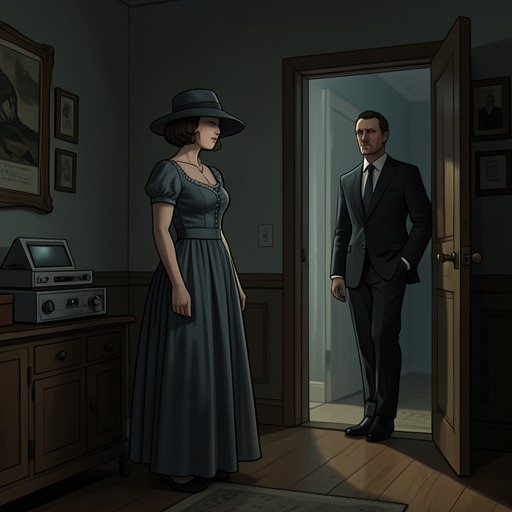
His appearance is carefully composed: a pale linen double-breasted suit, green shirt and silk tie, brown-and-white two-tone wingtips, a gold link bracelet, several rings, and a Rolex watch. Marlowe reads the clothing as a sign that Wiseman is doing well and jokes that he might look into the movie business himself. The contrast is pointed without suggesting that Wiseman has become a star: his place is behind the scenes, but the prosperous, polished look marks him as someone who has made the studio world work for him.
At the commissary, Wiseman leads Marlowe to Mandy’s table by a picture window. He greets her with a hand on one of her shoulder blades and introduces his visitor by name. Then he leaves them together, telling Mandy to keep an eye on Marlowe because “he’s not as harmless as he looks.” He soft-punches Marlowe on the shoulder as he goes. Mandy answers that Wiseman is a nice person, adding that this cannot be said of everybody in the business. The scene supplies a small measure of his standing: Mandy welcomes his presence, and his warning to her has the familiarity of a friend’s teasing rather than a formal security instruction.
Characterization and Narrative Role
Wiseman is drawn through a contrast between his relaxed manner and the compromising situations his work touches. He says little about the cases he helps manage, while Marlowe’s description makes clear that studio stars and executives can require help with drug, driving, and domestic-violence allegations. The contrast leaves Wiseman’s precise attitude toward those interventions unstated. What the episode establishes is his access to the Sheriff’s Office and his role in responding when the studio’s private troubles risk becoming public ones.
His friendship with Marlowe is expressed through recognition, banter, quick cooperation, and physical ease: a hand on Mandy’s shoulder, a soft punch to Marlowe, and a willingness to arrange a meeting without turning the favor into a negotiation. He is useful without becoming a second investigator. In the novel’s movement between private inquiry and the film industry, Wiseman is a hinge figure—someone whose ordinary workplace connections let Marlowe approach a witness, while his own work reveals how the studio contains and manages trouble.